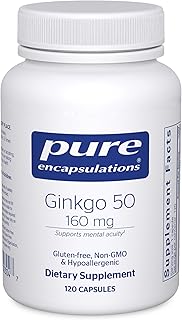
Ginkgo dosing questions deserve a straight answer grounded in what clinical trials actually used, not marketing-driven dose inflation. Here’s a beginner-focused framework based on the standardized-extract research base.
This post contains affiliate links. If you buy through them, we may earn a small commission at no extra cost to you. This does not influence what we recommend.
Typical Studied Dose Range
Most clinical trials that showed measurable circulation or cognitive effects used 120 to 240mg per day of standardized extract (commonly EGb 761 or an equivalent 24:6 flavone glycoside/terpene lactone ratio), usually split into two doses. Doses above 240mg/day have not shown reliably greater benefit in trials and increase the theoretical bleeding-risk exposure without established added upside.
A Reasonable Starting Approach
Beginners without a specific medical reason to start at the higher end can reasonably begin at 120mg/day (60mg twice daily) for the first one to two weeks to assess tolerance, particularly for mild GI upset or headache, then move to 240mg/day if the product and use case call for it and no adverse reaction occurred.
This start-low approach is a sensible tolerance check, not something specific trial protocols require. Most trials simply started participants at the target dose.
Reading a Label Correctly
Check for standardization language (24% flavone glycosides / 6% terpene lactones or EGb 761 specifically). Products that only list ‘ginkgo leaf extract’ without a standardization ratio are harder to compare to the studied doses and may vary significantly in actual active compound content between batches.
Why the Extract Ratio Matters More Than the Milligram Number
Two products can both say 120mg on the front label and deliver meaningfully different amounts of the compounds the trials measured. The milligram figure describes how much extract is in the capsule. The standardization ratio describes what that extract is actually made of. Without the second number, the first one tells you very little about how the product compares to the research.
This is why the 24 percent flavone glycoside and 6 percent terpene lactone specification keeps appearing. It is not a marketing tier, it is the composition the studied preparations were built to. A product hitting that ratio at 120mg is closer to trial conditions than a non-standardized product at 250mg, because the higher number in the second case is mostly plant material rather than concentrated active compounds.
Our explainer on EGb 761, the standardized extract behind the research covers where that specification came from and why so many trials converged on it.
Adjusting Over the First Three Months
A sensible first month is about tolerance, not results. You are checking whether you get headache or mild digestive upset, not whether anything has improved, because the trial timelines make improvement at four weeks unlikely to be measurable either way.
From roughly week four onward, if tolerance is fine and your use case matches the higher end of the studied range, moving up is reasonable. What is not supported is continuing to climb past the top of that range in search of a stronger effect. The trial evidence does not show a dose-response benefit up there, and the bleeding-risk exposure keeps increasing regardless.
The more useful adjustment after that point is usually to the product rather than the dose. If your current bottle does not state a standardization ratio, switching to one that does will change what you are actually taking far more than another 60mg of an unspecified extract would. Our guide to choosing between standardized extract and raw leaf walks through what to check on the label.
Two Common Beginner Mistakes
The first is treating the dose as the only variable and the duration as an afterthought. Someone taking 240mg for three weeks has run a much weaker experiment than someone taking 120mg for three months, because the trials that found anything ran for months.
The second is stacking a ginkgo product on top of a multi-ingredient nootropic blend that already contains ginkgo, which quietly puts the daily total somewhere you did not intend. Combination products often list ginkgo without making the amount easy to find, so it is worth reading the full supplement facts panel on everything you take before adding a standalone product.


Frequently Asked Questions
Is more ginkgo better for faster or stronger results?
No. Trial evidence does not support a dose-response benefit above roughly 240mg/day of standardized extract, and higher doses add bleeding-risk exposure without established additional benefit.
What if my product isn’t standardized to 24:6?
Effects may differ meaningfully from trial results. Prioritize products that clearly state standardization for anything approaching the research-backed dose.
Do I need to cycle or take breaks at this dose?
There’s no trial evidence requiring cycling at standard doses; most positive trials used continuous daily dosing for 12 to 24 weeks or longer.
Important safety note: Ginkgo biloba is often described as a blood thinner. Standardised extract does inhibit platelet aggregation and prolong bleeding time as a pharmacological property[1], but that is a proposed mechanism rather than a confirmed clinical effect: a meta-analysis of 18 randomised trials in 1,985 adults found no significant effect on platelet aggregation, fibrinogen concentration, aPTT or prothrombin time, and did not indicate a higher bleeding risk[2].
A review of controlled studies likewise found that ginkgo did not impair haemostasis or compromise the safety of coadministered aspirin or warfarin, while noting that an idiosyncratic bleeding event cannot be excluded and that isolated case reports do exist[3], including chronic ginkgo use preceding spontaneous subdural haematoma[4].
Those trials were not designed to establish safety in people who are already anticoagulated, so that specific question is open rather than answered. If you take warfarin, aspirin, clopidogrel, or any other blood thinner, or if you have a bleeding disorder or an upcoming surgery, talk to your doctor before starting ginkgo. This applies even to otherwise low-risk uses like memory support.
These statements have not been evaluated by the FDA. This product is not intended to diagnose, treat, cure, or prevent any disease.
References
- EGb 761: ginkgo biloba extract, Ginkor. Drugs in R&D, 2003
- Is there a risk of bleeding associated with standardized Ginkgo biloba extract therapy? A systematic review and meta-analysis. Pharmacotherapy, 2011
- Potential interaction of Ginkgo biloba leaf with antiplatelet or anticoagulant drugs: what is the evidence? Molecular Nutrition & Food Research, 2008
- Spontaneous bilateral subdural hematomas associated with chronic Ginkgo biloba ingestion. Neurology, 1996
These statements have not been evaluated by the Food and Drug Administration. This information is not intended to diagnose, treat, cure, or prevent any disease. Content is for informational purposes only and is not medical advice; consult a qualified healthcare provider before starting any supplement. As an Amazon Associate we earn from qualifying purchases.