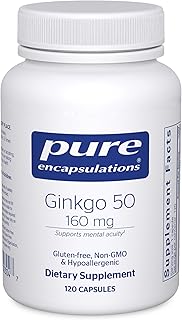
Ginkgo extract is sold in several forms, and the practical differences between them matter more for convenience and dosing accuracy than for effectiveness, as long as the underlying extract is properly standardized.
This post contains affiliate links. If you buy through them, we may earn a small commission at no extra cost to you. This does not influence what we recommend.
Capsules and Tablets
The most common form and the one used in the large majority of clinical trials. Pre-measured doses make it easy to match the studied 120-240mg/day range exactly, and standardization claims on capsule products are generally easier to verify via third-party testing since the format is simpler to manufacture consistently.

Liquid Extracts and Tinctures
Liquid ginkgo extracts offer flexible dosing (via dropper) and slightly faster absorption in some cases, but dosing accuracy depends heavily on the user measuring correctly, and concentration can vary more between brands than with standardized capsules. Alcohol-based tinctures also aren’t suitable for everyone.
Powders
Powdered extract, taken by weighing a dose or mixing into a drink, offers the most flexible dosing but the least dosing precision unless you have a milligram scale. Powders are also more prone to inconsistent standardization claims since the format is less common in the higher-oversight pharmaceutical-grade supply chain that produces most of the trial-quality extract.
Compare Cost per Standardized Milligram, Not per Bottle
Format comparisons usually go wrong at the price step, because bottle price and count are the two numbers products display most prominently and neither one answers the question. A 365-count bottle is not cheaper than a 120-count bottle in any meaningful sense until you know the milligrams per unit and the standardization behind them.
The comparison that works is cost per standardized milligram. Multiply the count by the milligrams per capsule, confirm the product actually states a standardization ratio, then divide the price by that total. Run it across the formats you are considering and the ranking often changes, because powders and liquids frequently look cheapest per bottle while delivering fewer standardized milligrams than the label implies.
If a product does not state a ratio at all, it cannot enter this comparison honestly, since you do not know what fraction of those milligrams is the material the research measured. Our guide to standardized extract versus raw leaf covers how to tell the difference on a label.
Storage, Shelf Life and Why Format Matters There
Format also determines how forgiving a product is once it is open. Sealed capsules limit each dose’s exposure to air and moisture to the moment you take it, which is part of why the format holds up well in a bathroom cabinet or a bag.
Liquids and powders are exposed repeatedly. Every opening of a powder tub admits air and humidity to the entire remaining supply, and dropper bottles reintroduce air with each use. That does not make either format unusable, but it does mean storage conditions and a realistic view of how quickly you will finish the container matter more than they do with capsules.
This interacts with quantity in a way large-count purchases can hide. A year’s supply is a good deal in capsule form and a less obvious one as an open powder tub, where the last portion has spent many months being opened daily.
Which Format Fits Which Situation
If your goal is to reproduce what the trials did as closely as possible, standardized capsules are the straightforward answer, and it is worth being clear that this is the main reason to prefer them rather than any absorption advantage.
Liquids earn their place mainly for people who have trouble swallowing capsules, or who want to titrate a dose in smaller increments than a capsule allows. Powders make sense mostly for people who already own an accurate milligram scale and will actually use it. Our overview of ginkgo formulations compares the options in more depth.
Frequently Asked Questions
Which form is used in most of the clinical research?
Standardized capsules and tablets, which is why they’re the easiest form to compare directly to published trial doses.
Is liquid extract absorbed faster than capsules?
Marginally in some cases, but the difference is unlikely to be practically meaningful given ginkgo’s effects build over weeks to months, not minutes to hours.

Is powder cheaper per dose?
Often yes, but the dosing precision tradeoff and more variable standardization make it a less predictable choice unless you’re comfortable weighing doses accurately.
Important safety note: Ginkgo biloba is often described as a blood thinner. Standardised extract does inhibit platelet aggregation and prolong bleeding time as a pharmacological property[1], but that is a proposed mechanism rather than a confirmed clinical effect: a meta-analysis of 18 randomised trials in 1,985 adults found no significant effect on platelet aggregation, fibrinogen concentration, aPTT or prothrombin time, and did not indicate a higher bleeding risk[2].
A review of controlled studies likewise found that ginkgo did not impair haemostasis or compromise the safety of coadministered aspirin or warfarin, while noting that an idiosyncratic bleeding event cannot be excluded and that isolated case reports do exist[3], including chronic ginkgo use preceding spontaneous subdural haematoma[4].
Those trials were not designed to establish safety in people who are already anticoagulated, so that specific question is open rather than answered. If you take warfarin, aspirin, clopidogrel, or any other blood thinner, or if you have a bleeding disorder or an upcoming surgery, talk to your doctor before starting ginkgo. This applies even to otherwise low-risk uses like memory support.
These statements have not been evaluated by the FDA. This product is not intended to diagnose, treat, cure, or prevent any disease.
References
- EGb 761: ginkgo biloba extract, Ginkor. Drugs in R&D, 2003
- Is there a risk of bleeding associated with standardized Ginkgo biloba extract therapy? A systematic review and meta-analysis. Pharmacotherapy, 2011
- Potential interaction of Ginkgo biloba leaf with antiplatelet or anticoagulant drugs: what is the evidence? Molecular Nutrition & Food Research, 2008
- Spontaneous bilateral subdural hematomas associated with chronic Ginkgo biloba ingestion. Neurology, 1996
These statements have not been evaluated by the Food and Drug Administration. This information is not intended to diagnose, treat, cure, or prevent any disease. Content is for informational purposes only and is not medical advice; consult a qualified healthcare provider before starting any supplement. As an Amazon Associate we earn from qualifying purchases.