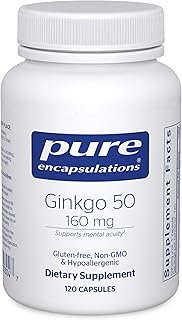
As women navigate the physiological shifts of midlife and menopause, many seek ways to support cognitive function and maintain energy levels. Herbal supplements like Ginkgo biloba and Panax ginseng are often discussed for these purposes, prompting questions about their individual benefits and potential differences.
This article explores the current understanding of Ginkgo biloba and Panax ginseng regarding their potential influence on cognition and energy. We’ll look at what the available evidence suggests for each, offering an evidence-based perspective for women considering these options.
Understanding Ginkgo Biloba for Cognitive Support
Ginkgo biloba, derived from the leaves of the Ginkgo tree, is one of the most widely studied herbal supplements for cognitive function. It has been recognized as a nootropic herb, meaning it may support cognitive processes [1].
Research exploring Ginkgo biloba’s influence on cognition often focuses on areas such as memory, attention, and executive function. While some studies suggest potential benefits, the overall evidence can be mixed, and findings may depend on the specific population studied, the dosage, and the duration of use.
For instance, one randomized trial investigated the effects of Ginkgo biloba on cognition and found that its impact could be modulated by individual cardiovascular reactivity [2]. Another study examined the effect of a single dose of Ginkgo biloba on driving performance and found no statistically significant difference from placebo [3]. These examples highlight the complexity of assessing its effects.


Panax Ginseng: Exploring its Impact on Cognition and Energy
Panax ginseng, often referred to simply as ginseng, is another well-known herb with a long history of use in traditional practices for supporting vitality and cognitive function. Like Ginkgo biloba, it is also categorized as a nootropic herb [1].
Ginseng is frequently explored for its potential to support mental performance and reduce fatigue, which could contribute to perceived energy levels. The mechanisms through which ginseng may exert these effects are a subject of ongoing research.
A randomized trial specifically looked at Panax ginseng’s effects on cognition alongside ginkgo and found that ginseng had no effect on cognition [2]. Another study investigated the impact of a single dose of Panax ginseng on driving performance, offering parallel insights to the Ginkgo biloba research [3].
Ginkgo vs. Ginseng: Are They Better Together?
Given that both Ginkgo biloba and Panax ginseng are studied for their potential cognitive benefits, some research has explored the effects of combining them. The idea behind combining them is often to achieve a synergistic effect, where the combined impact might be greater than that of either herb alone.

A systematic review specifically focused on research investigating the physiological and psychological effects of combining Ginkgo biloba and Panax ginseng into a single treatment. This review highlighted the implications for research design and analysis when studying such combinations [4]. It suggests that while combinations are explored, careful consideration of study methodology is crucial to understand their true effects.
It’s important to note that while both herbs are used as nootropic agents [1], and some studies compare them or combine them, their exact mechanisms and specific profiles of action are distinct. For example, some research has drawn parallels and differences between Ginkgo biloba and Panax notoginseng (a related species to Panax ginseng) in specific health contexts, such as ischemic cerebrovascular disease [5], indicating unique properties for each.
Which is ‘Better’ for Cognition and Energy in Midlife Women?
Determining which herb is ‘better’ is complex, as individual responses can vary greatly, and the research often presents mixed findings or focuses on specific aspects of cognition or energy. Both Ginkgo biloba and Panax ginseng are recognized as potential cognitive enhancers [1][6].
The available evidence suggests that both herbs have been investigated for their impact on cognitive function and energy, with studies often exploring their effects in various populations and contexts [2][3]. However, direct head-to-head comparisons specifically tailored to the unique experiences of midlife and menopausal women, with large, long-term studies, are still developing.
Ultimately, the choice between Ginkgo biloba and Panax ginseng, or whether to consider a combination, depends on individual needs, existing health conditions, and personal preferences. It’s crucial to approach these options with realistic expectations, understanding that supplements can support well-being but are not substitutes for a healthy lifestyle.
References
- Nootropic Herbs, Shrubs, and Trees as Potential Cognitive Enhancers. Plants (Basel, Switzerland), 2023
- Ginseng and Ginkgo Biloba Effects on Cognition as Modulated by Cardiovascular Reactivity: A Randomised Trial. PloS one, 2016
- Effect of single-dose Ginkgo biloba and Panax ginseng on driving performance. Clinical toxicology (Philadelphia, Pa.), 2015
- A systematic review of research investigating the physiological and psychological effects of combining Ginkgo biloba and Panax ginseng into a single treatment in humans: Implications for research design and analysis. Brain and behavior, 2019
- [Similarities and differences between Ginkgo biloba and Panax notoginseng in treatment of ischemic cerebrovascular disease]. Zhongguo Zhong yao za zhi = Zhongguo zhongyao zazhi = China journal of Chinese materia medica, 2020
- A Mini-review on Unlocking Cognitive Enhancement: An Innovative Strategy for Optimal Brain Functions. Central nervous system agents in medicinal chemistry, 2026
These statements have not been evaluated by the Food and Drug Administration. This information is not intended to diagnose, treat, cure, or prevent any disease. Content is for informational purposes only and is not medical advice; consult a qualified healthcare provider before starting any supplement. As an Amazon Associate we earn from qualifying purchases.