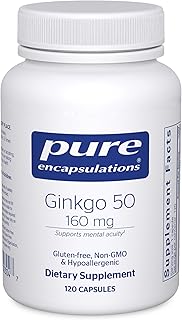
Vitamin C and ginkgo biloba are both antioxidants, which naturally raises the question of whether combining them amplifies antioxidant benefit. Here’s what’s actually established versus assumed.
This post contains affiliate links. If you buy through them, we may earn a small commission at no extra cost to you. This does not influence what we recommend.
Shared Antioxidant Category, Different Targets
Vitamin C is a water-soluble antioxidant active broadly throughout the body and essential for collagen synthesis and immune function. Ginkgo’s flavone glycosides are also antioxidants, but their studied activity is more specifically concentrated in vascular and neural tissue. Being in the same broad category (antioxidant) doesn’t automatically mean a measurable synergistic effect when combined; it means they’re not working against each other.
No Dedicated Synergy Trials
There isn’t a specific clinical trial base testing ginkgo plus vitamin C for an amplified effect. Claims of ‘synergy’ between generic antioxidant supplements are common in wellness marketing but usually outpace the actual combined-trial evidence, and this pairing is no exception.
Safety Profile of Combining
Vitamin C doesn’t carry meaningful antiplatelet activity, so it doesn’t add to ginkgo’s bleeding-risk profile. At very high doses, vitamin C can cause GI upset (diarrhea, cramping), which is a separate, unrelated tolerability consideration.
Why Antioxidant Stacking Sounds Better Than It Measures
Antioxidant is a description of chemical behaviour, not a category of interchangeable benefit. Compounds grouped under the term differ in where they are soluble, which tissues they reach, which reactive species they act on, and what the body does with them afterward. Two antioxidants can share the label and overlap very little in practice.
This is why adding antioxidants together has repeatedly failed to produce the additive results the framing suggests. The limiting factor in most cases is not the total quantity of antioxidant compounds available but where they can act and what is happening in that specific tissue, neither of which is improved by adding a compound that operates somewhere else.
Applied here, vitamin C’s activity is broad and water-soluble, while ginkgo’s studied flavone glycoside activity is concentrated in vascular and neural tissue. They are not competing, and they are also not stacking in any way that has been measured. Our page on ginkgo’s antioxidant and anti-inflammatory actions covers what has actually been studied on that side.
If You Take Both Anyway
There is a straightforward case for taking vitamin C that has nothing to do with ginkgo. It is an essential nutrient with a defined requirement, unlike ginkgo, which is optional by definition. Evaluating them separately is more honest than treating the pair as a strategy.
On practicalities, vitamin C is water-soluble and does not require food for absorption, though larger single doses are the most common cause of the digestive upset associated with it. Splitting a larger daily amount, or lowering it, generally resolves that, and it is unrelated to ginkgo.
There is no evidence-based reason to separate them in time. Taking both with a meal is simple and works, and simplicity is worth more here than any theoretical timing refinement.
What Would Change This Assessment
It is worth being clear that the absence of synergy evidence is not the same as evidence against it. No trial has tested this combination for an amplified effect, so the honest position is that the question is open rather than answered.
What would change the picture is a trial including a ginkgo-only arm, a vitamin C only arm, and a combination arm, measuring a defined outcome across all three. Until something of that shape exists, treating the pairing as two separate decisions is the position the evidence supports. Our page on ginkgo’s antioxidant properties and brain health covers where the single-ingredient evidence currently stands.


Frequently Asked Questions
Does vitamin C boost ginkgo’s antioxidant effect?
There’s no dedicated trial evidence establishing a measurable synergistic effect; both are antioxidants but act through different pathways in different tissues.
Is it safe to combine them daily?
Yes, no specific interaction risk is documented, and vitamin C doesn’t compound ginkgo’s bleeding-risk considerations.
Should I take vitamin C at a specific time relative to ginkgo?
No evidence-based timing requirement exists; taking both with a meal is a simple, reasonable approach.
Important safety note: Ginkgo biloba is often described as a blood thinner. Standardised extract does inhibit platelet aggregation and prolong bleeding time as a pharmacological property[1], but that is a proposed mechanism rather than a confirmed clinical effect: a meta-analysis of 18 randomised trials in 1,985 adults found no significant effect on platelet aggregation, fibrinogen concentration, aPTT or prothrombin time, and did not indicate a higher bleeding risk[2].
A review of controlled studies likewise found that ginkgo did not impair haemostasis or compromise the safety of coadministered aspirin or warfarin, while noting that an idiosyncratic bleeding event cannot be excluded and that isolated case reports do exist[3], including chronic ginkgo use preceding spontaneous subdural haematoma[4].
Those trials were not designed to establish safety in people who are already anticoagulated, so that specific question is open rather than answered. If you take warfarin, aspirin, clopidogrel, or any other blood thinner, or if you have a bleeding disorder or an upcoming surgery, talk to your doctor before starting ginkgo. This applies even to otherwise low-risk uses like memory support.
These statements have not been evaluated by the FDA. This product is not intended to diagnose, treat, cure, or prevent any disease.
References
- EGb 761: ginkgo biloba extract, Ginkor. Drugs in R&D, 2003
- Is there a risk of bleeding associated with standardized Ginkgo biloba extract therapy? A systematic review and meta-analysis. Pharmacotherapy, 2011
- Potential interaction of Ginkgo biloba leaf with antiplatelet or anticoagulant drugs: what is the evidence? Molecular Nutrition & Food Research, 2008
- Spontaneous bilateral subdural hematomas associated with chronic Ginkgo biloba ingestion. Neurology, 1996
These statements have not been evaluated by the Food and Drug Administration. This information is not intended to diagnose, treat, cure, or prevent any disease. Content is for informational purposes only and is not medical advice; consult a qualified healthcare provider before starting any supplement. As an Amazon Associate we earn from qualifying purchases.